August 27, 2026 • Cassidy Vane • 11 min reading time • Prices verified June 6, 2026
Saucony Spitfire 5 vs. ASICS Hypersprint 8: The Mid-Price Sprint Spike Head-to-Head
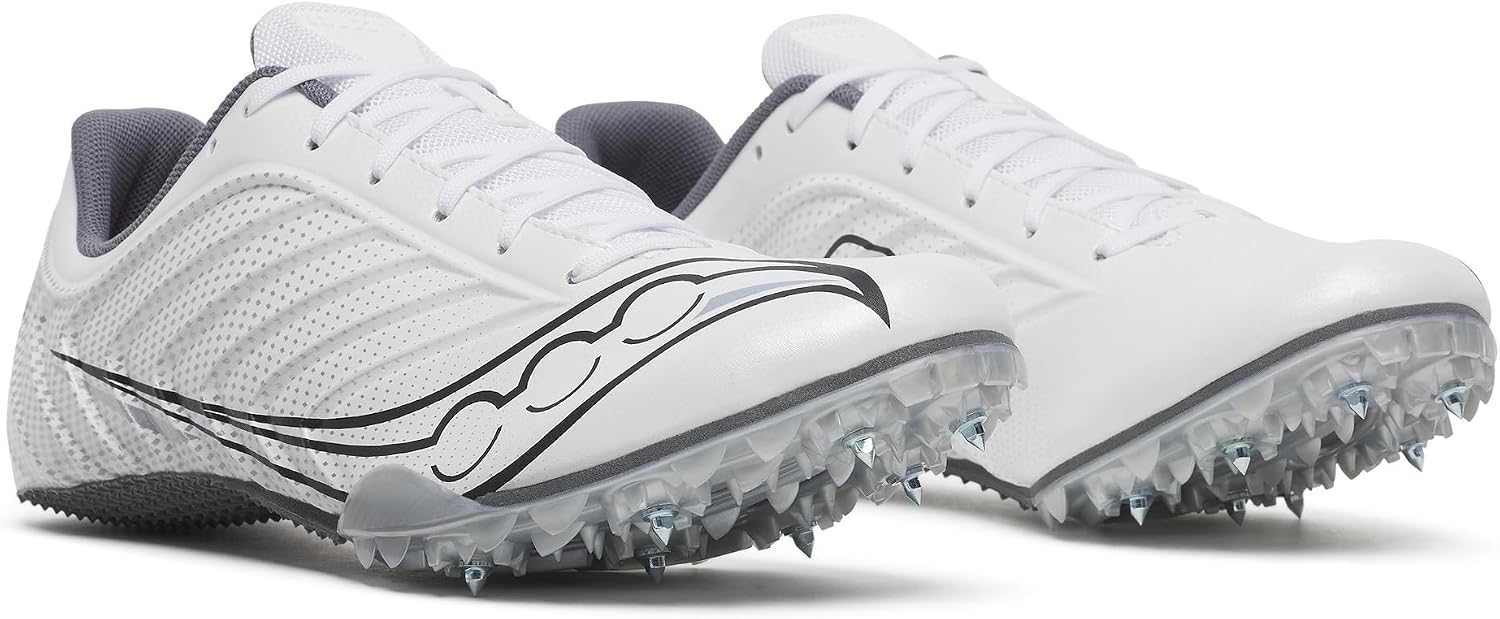
Sprint spikes — track shoes with a stiff plastic or carbon plate in the forefoot and threaded holes for small metal or ceramic pins — are purpose-built to let sprinters push off the track with maximum force and minimum wasted motion. Unlike everyday running shoes, they have virtually no heel cushioning and almost no padding; the whole design is about transferring power forward. If you’re shopping for your first real sprint shoe, or helping an athlete pick one, that context matters: these shoes feel strange to walk in and are not meant for jogging warm-ups. They exist to go fast on a track oval, specifically in short races from the 100 meters through the 400 meters. This article compares two popular mid-price options — the Saucony Spitfire 5 and the ASICS Hypersprint 8 — so you can make a confident choice before the season starts.
If you already know what a 7-pin plate and needle spikes are, you’re in the right place. If those terms are new, stick with us: we’ll define them as we go and then get into the detail that serious athletes care about.
| EDITOR'S PICKASICS Unisex Hypersprint 8 Trac… | Mid-tierASICS Unisex Hypersprint 8 Trac… | Budget pickSaucony Men's Spitfire 5 Track… | |
|---|---|---|---|
| Brand | ASICS | ASICS | Saucony |
| Model | Hypersprint 8 | Hypersprint 8 | Spitfire 5 |
| Gender | Unisex | Unisex | Men's |
| Size (W) | 11.5 | 12 | — |
| Size (M) | 10 | 10.5 | 8.5 |
| Colorway | Soothing Sea/Black | White/Cobalt Burst | White/Carbon |
| Price | $74.95 | $69.95 | $54.95 |
| See on Amazon → | See on Amazon → | See on Amazon → |
What You’re Actually Comparing
Before diving into model specifics, it’s worth anchoring the comparison. Both shoes live in the same tier: mid-market sprint spikes priced to serve high school athletes, club competitors, and serious recreational runners who want real spike hardware without committing to the $200-plus carbon-plate tier occupied by shoes like the Nike Air Zoom Maxfly or Adidas Adizero Prime SP2.
By the numbers:
| Feature | Saucony Spitfire 5 | ASICS Hypersprint 8 |
|---|---|---|
| Approximate retail | ~$65–$75 | ~$60–$75 |
| Spike pins included | 7-pin configuration | 6-pin configuration |
| Primary target events | 100m / 200m / 400m | 100m / 200m |
| World Athletics compliant | Yes (standard pin config) | Yes (standard pin config) |
Both shoes are designed as entry-to-mid-tier sprint spikes, and both earn solid aggregate marks from the buyers who have reviewed them. But the patterns in those reviews reveal real differences in who each shoe actually suits.
Head-to-Head: Fit, Plate, and Event Range
Fit and Sizing
The Saucony Spitfire 5 earns consistent praise for a predictable, glove-like lockdown fit. A secure, snug fit matters enormously in sprint spikes — a shoe that shifts during a race is both a performance problem and an injury risk. Reviewers across multiple purchasing channels report that the Spitfire 5 delivers reliable lockdown and runs true to size. For parent buyers in particular, that sizing predictability reduces the guesswork on first-time online orders, which is a meaningful practical advantage.
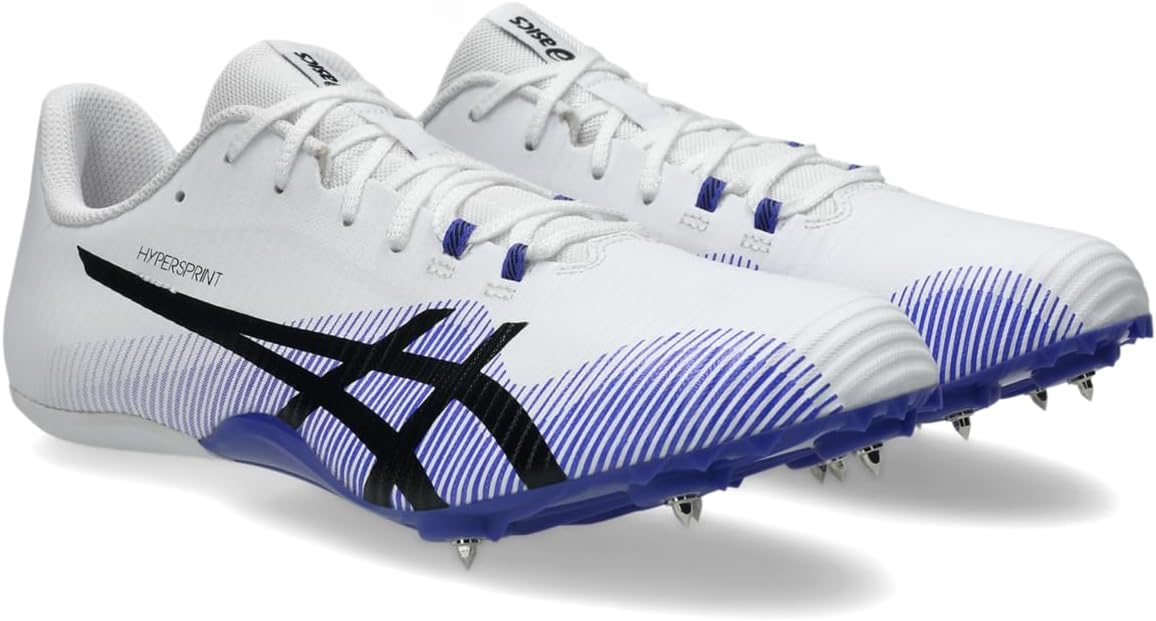
The ASICS Hypersprint 8 tells a different story on sizing, and it’s the most important piece of information in this entire comparison: size up. Multiple buyers across different purchasing platforms report that the Hypersprint 8 runs small. A related ASICS XC model in the same performance line carries at least one reviewer report of left-foot cramping under high-effort load — not from break-in friction, but from the fit constricting during the explosive push of a race. That pattern appears across enough ASICS performance-spike reviews to treat it as a consistent brand-level sizing note rather than a one-off complaint.
As Runners World’s guide to track spike fitting notes, sprint spikes should fit snugly but should never create pressure points in the toe box, because even minor constriction affects push-off mechanics. A half-size adjustment at order time is far less painful than a race-day blister or a return window fight. The practical rule: if your athlete normally wears a men’s 9, order a 9.5 in the Hypersprint 8. If between sizes, go up.
ASICS
$69.95
In stock on Amazon
Check price on AmazonPlate Performance and Cushioning
The Saucony Spitfire 5’s 7-pin plate is consistently described by reviewers as “decent” or “functional” rather than energizing. That language matters. It means the plate does its job — stiffening the forefoot to help you push off the track — but it does not generate the propulsive snap that athletes report from higher-end nylon or carbon constructions. Cushioning reviews follow a similar pattern: the Spitfire 5’s underfoot feel has drawn at least one detailed critical assessment describing it as underwhelming relative to its price point. To be fair, no sprint spike is meant to feel like a road trainer, and cushioning expectations need to be calibrated to the category. But reviewers flagging this issue are often athletes who used the Spitfire 5 before upgrading, and the contrast they describe is real.
Podium Runner’s sprint spike buying guide explains that mid-tier plate stiffness typically relies on a single-layer nylon construction rather than the multi-layer or fiber-reinforced plates found in premium models — which maps directly onto what Spitfire 5 reviewers are reporting. “Decent and functional” is not a failure; it’s an accurate description of what single-layer nylon delivers, and for a developing athlete it is entirely appropriate.
The ASICS Hypersprint 8 positions itself as a dedicated short-sprint tool, and reviewers who nail the fit consistently describe it as feeling fast and purpose-built for 100m and 200m racing. Its 6-pin configuration is standard for those distances and appropriate for high school competition. The geometry is aggressive — steep forefoot angle, minimal heel — which suits the explosive acceleration phase of short sprints but creates more cumulative strain across the sustained effort of a full 400 meters.
ASICS
$69.95
In stock on Amazon
Check price on AmazonEvent Range and Versatility
The Saucony Spitfire 5 is the more versatile option across sprint distances. Its 7-pin configuration and slightly less aggressive forefoot geometry give it utility from the 100m through the 400m. That breadth matters for high school athletes who may not yet have settled into a primary event, or who compete across multiple sprint distances in the same meet. Track & Field News has reported extensively on how plate geometry — specifically forefoot angle and plate stiffness — affects performance across sprint distances, noting that a steeper, stiffer plate optimized for the acceleration phase of a 100m can work against an athlete during the sustained top-speed effort required over 400 meters. The Spitfire 5’s more moderate geometry reflects a deliberate design choice toward multi-event usability.
The ASICS Hypersprint 8 is more clearly a 100m and 200m specialist. Its steep forefoot geometry and minimal construction are optimized for explosive short efforts; asking a Hypersprint 8 to cover a full 400 meters introduces more strain and fatigue than the shoe’s design anticipates. Neither shoe is a true 400m specialist — that category calls for a slightly lower forefoot angle and more midfoot support — but between the two, the Spitfire 5 handles multi-distance demands more comfortably.
ASICS
$69.95
In stock on Amazon
Check price on AmazonThe Decision Frame: Which One for Your Situation?
This is where the comparison earns its keep. Here are the decision rules, laid out clearly:
First-year high school sprinter, event undecided, ordering online without trying on: The Saucony Spitfire 5 is the safer choice. Its true-to-size fit behavior reduces return risk, its 7-pin configuration is versatile across sprint distances, and its “decent but functional” plate is appropriate for a developing athlete who doesn’t yet have the biomechanics to maximize what a stiffer plate offers anyway. The cushioning criticism that appears in some reviews is not a dealbreaker at the developmental level — it’s simply a reminder that this shoe is priced and built for the mid-tier.
Committed short-sprint specialist, 100m or 200m primary event, knows their size: The ASICS Hypersprint 8 is a reasonable option — provided you size up deliberately. Order your normal size and you risk a shoe that cramps under race-effort load. Order a half size up and reviewers report a well-fitting, capable sprint shoe that delivers on its short-sprint promise.
Club competitor or masters athlete evaluating these against the next price tier: Both shoes are honest mid-market options, but neither offers the plate response of carbon or multi-layer fiber construction. Track & Field News has consistently covered the plate-stiffness arms race in sprint footwear, noting that the performance delta between nylon and carbon plates is most pronounced for athletes who already have strong sprint mechanics — which is the exact population weighing whether a step up is justified. If you’re running sub-11 in the 100 or sub-23 in the 200 and competing seriously at the club or masters level, the gap between these shoes and the $150–$225 tier is real and worth budgeting for.
Coach sourcing spikes for a full roster on a school budget: The Spitfire 5’s more consistent sizing behavior gives it a meaningful edge in bulk orders where you cannot afford widespread returns. The ASICS sizing issue, while manageable for a single buyer who knows to size up, becomes an administrative problem at roster scale. The Spitfire 5’s true-to-size behavior simplifies ordering and reduces the likelihood of ill-fitting shoes on meet day.
Frequently Asked Questions
Should I size up in the ASICS Hypersprint 8? Yes, and this is not optional advice. Multiple reviewers across purchasing platforms report that the Hypersprint 8 runs small, with a pattern of foot constriction under race-effort load appearing in reviews of related ASICS performance models in the same product family. Order at least a half size up from your normal training shoe size. If you’re on the border between two sizes, go to the larger one.
Is the Saucony Spitfire 5 legal for high school track meets? Yes. The Spitfire 5 uses a standard threaded spike pin configuration and accepts legal spike lengths for track surfaces. Per World Athletics’ Technical Rules on competition shoes — the international governing document that most high school and collegiate rules trace back to — the key compliance factors are spike pin length (maximum 9mm for most track surfaces) and shoe stack height. The Spitfire 5 meets standard requirements, but always confirm with your state athletic association, as rules can vary slightly by governing body. Your coach will have the relevant NFHS (National Federation of State High School Associations) sport-specific rulebook on file.
How does the 7-pin plate on the Spitfire 5 compare to 8-pin budget options? Pin count is less important than pin placement and plate stiffness. The 7-pin layout on the Spitfire 5 is a standard sprint configuration that covers forefoot traction effectively. Some budget spikes use 8 pins, but if the plate itself is less stiff or the pin placement is optimized for a different event, an 8-pin shoe isn’t automatically better. As Podium Runner’s sprint spike buying guide explains, the plate construction — specifically the material and layering — is the primary performance variable at this price tier, not the pin count.
Can either of these shoes handle the 400m? The Saucony Spitfire 5 can reasonably serve a 400m runner, particularly at the developmental or JV level. The ASICS Hypersprint 8 is more clearly optimized for 100m and 200m; its steep forefoot angle and minimal construction make it less suited for the 52–60 second sustained effort a 400m demands. If one athlete needs to compete across both short sprints and the 400, the Spitfire 5 is the better single-shoe solution.
How often will I need to replace the spike pins? Spike pins wear down with use, especially on all-weather rubber tracks. Most athletes replace pins every two to four weeks during active competition season, or whenever the tips become blunt or grip feels less secure. Both the Spitfire 5 and Hypersprint 8 use standard threaded spike holes that accept universal replacement pins, which are widely available and inexpensive. Keep a spike wrench in your bag — most spike shoes include one — and check pin tightness before every race, as pins can loosen with repeated use.
The Bottom Line
Neither shoe is a bad choice. Both are honest, competitively priced sprint spikes that will serve a developing high school athlete or recreational competitor well through a full season. The Saucony Spitfire 5 earns the edge for versatility, sizing predictability, and usefulness across multiple sprint events — while being clear-eyed that its single-layer nylon plate won’t deliver the energized push of a premium model. The ASICS Hypersprint 8 is a capable 100m and 200m tool as long as you size up, and its reviewers who nail the fit are consistently satisfied with the shoe’s purpose-built feel.
If you’re choosing between them: go Spitfire 5 if fit certainty and event flexibility matter most; go Hypersprint 8 (sized up) if your athlete is a committed short-sprint specialist who wants a more focused tool. Either way, you’re in a reasonable tier for the money — and if the athlete outgrows either shoe within a season, that’s actually a good problem to have.