August 29, 2026 • Cassidy Vane • 9 min reading time • Prices verified June 6, 2026
Sprint Spikes for the 100–400m: Matching Plate Stiffness and Spike Config to Your Event
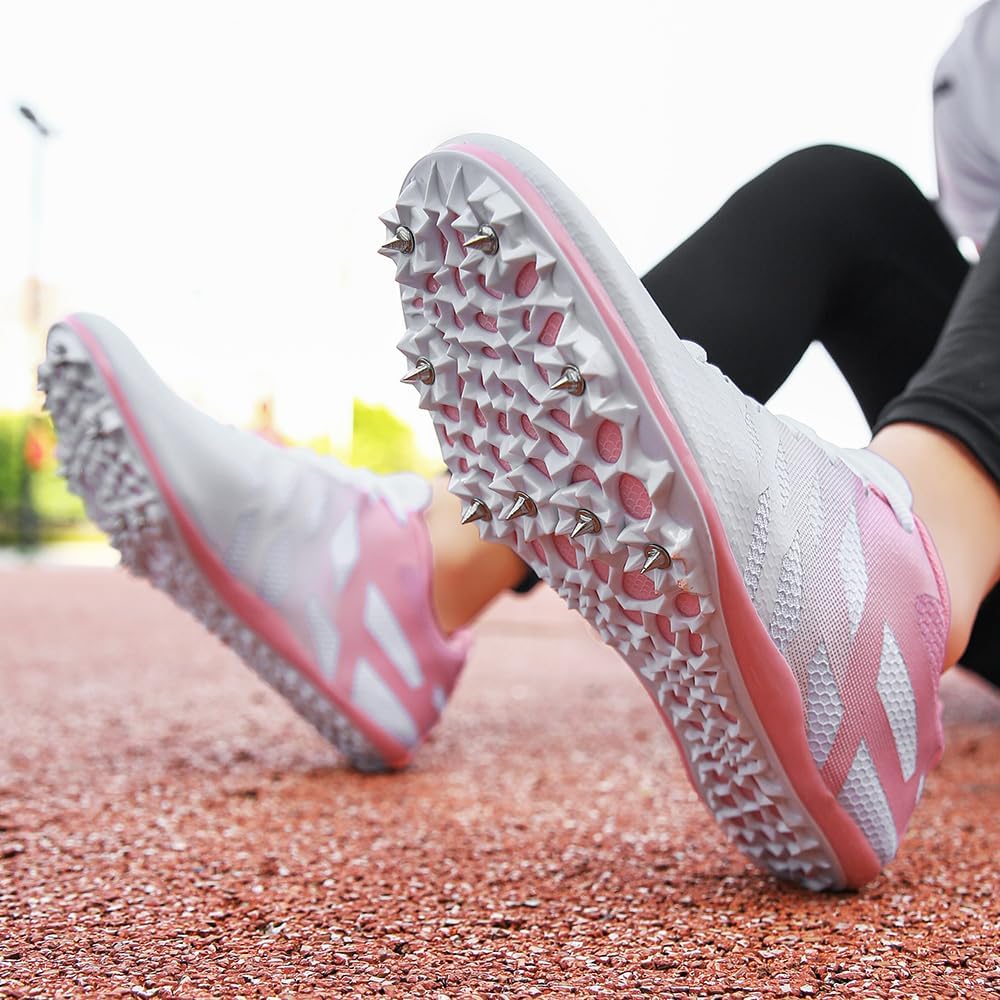
If you’ve ever stood in a track store holding two different sprint spikes — both labeled “for sprinters,” both priced somewhere between uncomfortable and alarming — and wondered why they feel completely different, you’re not imagining things. Sprint spikes (shoes designed specifically for short, fast races on a track, built with a stiff plate in the sole and metal pins called spikes in the forefoot) are not one-size-fits-all within the sprint family. A shoe engineered to win a 100m final is genuinely mismatched for a 400m athlete grinding through a 47-second race. The difference comes down to two things that shoe companies love to gloss over: plate stiffness (how rigid the energy-return structure in the sole is) and spike configuration (how many pins, where they sit, and at what angle). Get those two variables right for your event, and the shoe becomes a tool. Get them wrong, and you’re fighting your footwear every step.
This guide maps plate stiffness and spike config to the 100m, 200m, and 400m specifically — with current model callouts, the math on when premium hardware pays off, and clear decision rules for athletes who are past the “just grab whatever fits” stage but still building their equipment intuition.
Why Plate Stiffness Isn’t One Number — and Why It Matters by Event
The carbon-fiber or composite plate embedded in a sprint spike’s sole functions like a lever: it resists bending under load and then snaps back, redirecting energy forward rather than letting it dissipate through a soft midsole. Manufacturers measure this as bending stiffness, typically in Newton-meters per degree (Nm/°), though they rarely publish the raw figure. What they do publish — sometimes — is which events they target the shoe for, and that targeting reflects real engineering choices.
For the 100m and 200m, race duration is short, contacts are violently brief, and athletes are almost exclusively on the forefoot. The ideal plate here is maximally stiff — close to unbendable — because every ground contact is an explosive push, not a rolling stride. Podium Runner’s analysis of carbon-plate sprint hardware notes that top-tier 100m spikes are built to resist flexion almost entirely, essentially turning the foot into a rigid lever arm. The Nike Air Zoom Maxfly ($225), built around Nike’s stiff full-length carbon plate and an aggressive 6-spike configuration, is the clearest current expression of this philosophy. Owners and coaches consistently report that the Maxfly’s plate feels locked compared to distance shoes — intentionally so.
For the 400m, the calculus shifts. A 400m athlete makes contact with the track roughly 180–220 times over the course of a race. That’s not 100m physics anymore. The plate still needs to be stiff enough to return energy efficiently, but total rigidity becomes a liability: it fatigues the lower leg faster, and it doesn’t accommodate the subtle mid-race gait adjustments athletes make as lactate builds. Flotrack’s reporting on plate engineering in the 400m context points to a middle-zone stiffness — call it “progressive stiffness” — where the plate resists bending under peak load but allows slightly more natural flexion at lower forces. The Adidas Adizero Prime SP2 ($250) sits in this zone, with Adidas’s Energyrods (a bundle of carbon rods rather than a single plate, designed to tune flex response by zone) offering differentiated stiffness across the forefoot versus midfoot.
By the numbers:
| Event | Ideal plate profile | Spike count (typical) | Example model | MSRP |
|---|---|---|---|---|
| 100m | Maximum stiffness, full forefoot lock | 6–7 pins | Nike Air Zoom Maxfly | $225 |
| 200m | Maximum–high stiffness, slight lateral bias | 6 pins | Adidas Adizero Prime SP2 | $250 |
| 400m | High-moderate stiffness, progressive flex | 5–6 pins | Adidas Adizero Prime SP2, Puma evoSPEED Sprint 14 | $200–$250 |
Spike Configuration: Pins, Angles, and the Ground Contact You’re Actually Making
The metal pins screwed into the forefoot of a sprint spike aren’t cosmetic — their number, placement, and tip geometry directly affect how the shoe grips the track and how that grip translates to propulsion.
Pin count is the first variable. Most sprint spikes run 5–7 pins. Higher counts (6–7) spread the load across more contact points, which helps with traction on wet or worn track surfaces but adds marginal weight. Five-pin configurations prioritize weight savings and are increasingly common in elite short sprint shoes. Track & Field News’s 2025 shoe directory notes that the trend over the past two seasons has moved toward 6-pin configurations in 100/200 spikes after several elite athletes and coaches reported inconsistent traction with 5-pin setups on certain track surfaces.
Pin placement matters more than count for event-specific performance. For pure 100m use, you want pins concentrated in the extreme forefoot — under the metatarsal heads and toes — because that’s where force is being applied. For 400m, where athletes touch down slightly further back on the foot in the middle sections of the race, a configuration that extends slightly toward the midfoot provides better support during those less-aggressive contacts.
Spike tip geometry breaks down into three common types:
- Pyramid spikes — the standard pyramid-shaped metal tip. Legal for most track surfaces, good all-around grip. These are what most athletes run.
- Needle spikes — very thin, long, penetrating. Better on older, softer tracks. World Athletics Technical Rules (Rule 5) specify maximum spike length at 9mm for track events on synthetic surfaces — worth checking if you’re buying third-party spikes separately.
- Christmas tree / compression spikes — wider at the base, designed for better grip on very firm, modern Mondo-surface tracks. Increasingly used at major championships.
Most sprint spikes ship with pyramid spikes installed. If you’re racing on an older track with a softer surface — common at many high school and mid-level collegiate venues — needle spikes can noticeably improve traction. The cost is trivial ($5–10 for a set), the performance difference is real, and it’s one of the most underused performance levers at the high school level.
100m vs. 200m vs. 400m: The Honest Decision Framework
Here’s where the practitioner-level tradeoff lives. You need to pick a spike for your primary event, possibly with a secondary event in mind. These are not the same shoe.
If your primary event is the 100m or 200m: The shoe market is genuinely excellent right now for you. The Nike Air Zoom Maxfly and Adidas Adizero Prime SP2 are both World Athletics–approved (confirmed on the World Athletics approved spike list, current 2025–26 edition) and represent the clearest expressions of stiff-plate, forefoot-aggressive sprint geometry available to non-professional athletes. Owners of the Maxfly consistently highlight its aggressive heel lockdown and the sense that the plate doesn’t “give” under the explosive acceleration phase — that’s the intended experience. The Prime SP2 owners note it feels slightly more forgiving in turnover without sacrificing much propulsion, which explains its cross-popularity with 200m specialists.
If budget is a constraint: the Adidas Adizero Ambition ($120) uses a TPU plate rather than full carbon and lands well below the flagship tier. Coaches at the club and JV level have reported it holds up well for sub-elite sprint use. It’s not the same shoe — the plate stiffness is meaningfully lower — but the gap matters less at training paces and for athletes still developing their mechanics.
If your primary event is the 400m: This is where the advice diverges from the marketing. The 100m spike on a 400m athlete is not a neutral choice — it’s a bet that your lower leg durability is high enough to absorb the cost of a maximally stiff plate over a full lap. For many high school athletes and developing collegiate runners, that bet loses. Across aggregated reviews and coach commentary on Flotrack, the pattern is consistent: athletes who move from a purpose-built 400m spike into a pure 100m spike often report calf and Achilles fatigue in the back half of the race, particularly as conditioning improves and they’re running faster later in the season.
The decision rule: if you’re running 400m as your primary event and your PR is above 50 seconds (men) or 57 seconds (women), the stiffness penalty of a 100m spike is actively working against you. A shoe with a more progressive plate — the Prime SP2, the New Balance MD500v9 (which Running Warehouse’s spec pages note bridges sprint and middle distance applications) — fits your race better than the Maxfly does.
If you’re running both 400m and 200m in the same meet: Most athletes at the high school and club level can’t justify two pairs of event-specific spikes. The honest answer is: buy for your primary event and accept the compromise on the secondary. If you run more 400s than 200s, lean toward the more progressive plate. If you’re primarily a 200m runner who occasionally runs anchor on the 4x4, the 100m/200m spike is correct and the 400m is a one-off compromise, not a hardware problem.
World Athletics Compliance: Don’t Skip This Step
Since the 2024 cycle, World Athletics has maintained a published approved shoe list for track events — and several flagship models from major brands have appeared on and off that list as manufacturers chase the 20mm sole thickness limit for sprint spikes (compared to 25mm for distance events). Before you spend $225 or $250 on a spike for a sanctioned meet, verify the current model year is listed on the World Athletics approved shoe list (found on worldathletics.org under Technical Information). This matters most for athletes competing at state championships and above; it’s less operationally relevant for most JV and club competition but worth knowing.
The Maxfly and Prime SP2 are approved in their current iterations as of mid-2026. Colorway-only updates to existing models typically don’t affect approval status, but a genuine midsole or plate revision can trigger a re-review. Track & Field News’s 2025 shoe directory flags this as an ongoing area of confusion for athletes buying mid-season.
The Clear “If X, Then Y” Summary
- If you’re a 100m/200m specialist with a budget above $200: Nike Air Zoom Maxfly or Adidas Adizero Prime SP2 are purpose-built for you. Verify World Athletics approval before sanctioned meets above the regional level.
- If you’re a 400m primary athlete: Choose the Prime SP2 over the Maxfly. The plate profile fits your race geometry better. Don’t let the marketing copy from 100m campaigns talk you into the wrong tool.
- If you’re under $150 and still developing: The Adidas Adizero Ambition or Adizero SC is the honest call. You don’t need carbon-fiber stiffness yet; you need a consistent surface and clean mechanics. Save the premium hardware for when your PR justifies it.
- If you’re buying replacement spikes: Match the tip type to your track surface — needle for softer tracks, pyramid or Christmas tree for modern Mondo. A $7 spike swap can outperform a $50 insole upgrade.
- If you run two sprint events in the same meet: Buy for your primary. The compromise on the secondary is smaller than the cost of mismatching both.
Plate stiffness and spike configuration aren’t marketing variables — they’re engineering decisions that have real consequences at race speed. Once you know which variables map to your event, the spike selection decision gets a lot cleaner.